
From Birds(?) to Birds(!)

2012
Ending patrol for the day at 7:45 AM, I was in my last field training phase to become a Barnstable Police Officer. One of the only tasks I needed to have signed off on was the “Unattended Death.” During our initial training, Michael the white-haired long-time training commander, would speak sarcastically, “Not everyone will get the unattended signed off while in field training. Unfortunately, people aren’t willing to die for all of you to complete these tasks.” Michael was sarcastic, highlighting a common trait of those who work responding to trauma. He had investigated enough crime scenes to know that dark humor can lessen the reality of many shocking accidents, calamities, and deaths police encounter.
My Field Training Officer (FTO), Matt, signed me off on the task after we responded to a call to a Hyannis house where the reporting party’s mother had awakened to his father unresponsive and not breathing. When we arrived, Hyannis Fire Department was already on the scene, providing CPR in the man’s bedroom. I touched the man’s skin, and his body temperature was cool. His eyelids were open, and he had a dead stare. I tried not to look at the man’s face, but I made eye contact with his eyes.
I remember reading about the eyes of the dead in Henry David Thoreau’s Cape Cod when he describes shipwreck victims he saw after the St. John, a brig from Ireland, crashed full of emigrants. He saw the victims and described their “wide-open and staring eyes, yet lustreless, dead-lights; or like the cabin windows of a stranded vessel, filled with sand.”
For a few nights, when trying to fall asleep, a mental image of that man’s face, staring with lustreless eyes, flashed in my mind. My FTO told me I stayed calm when some people didn’t. “Some new guys need to step out. Some even vomit. You did fine.” He signed me off on the Unattended Death task, and I was one step closer to being alone on patrol.
Steve, my first FTO, was in the hallway as we waited for our shift to end, and his shift was beginning. Matt told Steve about our last call, and Steve said that even small calls like that could build up. He mentioned someone who used to work here and was a great cop the whole time. Unexpectedly, the man resigned from Barnstable PD, is now in a low-stress job, and spends much time birding. “Birding can be peaceful, and I think it helps him deal with memories.”
I couldn’t believe that he had said something so stupid, and I thought it ludicrous that animals flying around would help with innumerable traumas I remembered and thought of often. My face scowled, eyebrows furrowed, and I shrieked, “Birds?!.” I looked at Steve, Matt, and the hallway walkers in disbelief. “Birds!? Are you fucking serious? Birds?! You’re out of your god-dammed mind if you think birds will help with stress.” Walking down the hallway towards the locker, I scoffed, “Birds!”
I went home and tried to go straight to bed. At 6:00 am, the man who died’s son asked me if he could still see a movie with his dad at the mall later today, and at 8:15, I was trying to sleep. I couldn’t help but think that the family was at the hospital now, likely finding out their family member wasn’t coming home. It was like his face printed on the back of my eyelids as a negative; my eyelids were a blank projector screen, and his face was projecting. At first, when I closed my eyes, these images stayed, but with each attempt, I could ignore these thoughts because I knew I needed to sleep. After a few days, the images faded and only came up occasionally.
Detachment
This trajectory is how a lot of traumatic events went for me. When the images and thoughts of a man with his dead eyes, hanging bodies, and Iraqi street violence flash across my consciousness, I learn to ignore them. I knew I wasn’t seeing them; they weren’t real—a figment of my imagination. If I acknowledge these thoughts, I give them credibility.
Likewise, in moments of response, like giving CPR to a man who attempted suicide by hanging and was cut down by his wife before his heart completely stopped, I could ignore the feelings of wanting to leave. I can ignore the trauma-induced reduced cognition and focus on forming a good C-shape on the BVM so his chest rises and falls as I give him breaths. I can ignore the desire to vomit and keep going. I tried to focus on what I was doing and not look into his face, eyes, or the scar forming across his neck. I tried not to think about it; I dissociated these feelings from what was happening.
I left the Police Department for a job helping veterans because I wasn’t ready to stop ignoring those thoughts – or drinking. Without the purpose included in my duties as a Police Officer and the motivation to remain relatively sober, the memories and images intruding into my thoughts were outplaced and overwhelming. Everything in my life was unmanageable, but alcohol and full-blown detachment from my thoughts, feelings, and emotions allowed me to coast miserably. The disassociation was a detachment from reality. I ignored as much input as possible and felt disconnected from myself and the world around me.
After several months of emotionally spiraling as a Veteran Advocate, I decided to tell my doctors about my alcohol consumption. This one decision changed my life for the better and started me on the journey where I am today.
I was inpatient at the Department of Veteran Affairs when I learned how to achieve sobriety and the benefits of mindfulness and focused therapy. This therapy helped lift the fog that opaqued me from my thoughts. I was scared of them. Why was I still trying to find meaning in things that happened in combat?” The 3-8 Cavalry commander died in a suicide attack in 2009. He was my commander, and it felt like I could have, or should have, helped or prevented it.
“Focus on the work,” I told myself, but my cognition dropped, and these memories worked my brain to a frothy lather. These memories replayed while I was trying to work and take care of myself. I felt the events of the attack as I ignored them.
A Toolbox of Skills
In 2019, I began seeing clinicians at Home Base, a Boston-based Veteran and family mental clinic supported by Massachusetts General Hospital. It was here I gained practice in noticing what I was thinking and either accepting it or challenging thoughts. Instead of ignoring thoughts, I tried to watch them without judgment. Sometimes my thoughts and feelings were based on real-life experiences. More often, intrusive thoughts sink my thoughts into a cycle of a search for meaning. The face of someone I gave CPR flashes, and I try to figure out what I did wrong that day. I see a tree snag rocking in the woodline behind my house, and it brings flashes of images of bodies that once hung from lashings. An unexpected sound triggers memories of the day our commander died, and I try to figure out what I could have done to prevent the death.
In my therapy, I tried to notice what I was thinking or seeing and to check the facts. Though I gave credit to my emotions based on these symptoms, it is factual that I was not giving CPR, securing the scene of suicide for processing, or was I in combat in Iraq right then. I learned to notice my thoughts and feelings and accept them. What I once thought was a path to reexperiencing my trauma in new ways helped me see what was happening in the moment and gave me something tangible to bring my thoughts back to.
“What do you like to do,” Matt, my Home Base social worker, asked in a private room. I had suicidal thoughts myself and didn’t see a reason I would like to do anything. I didn’t like the feeling of existing and didn’t want to do anything. “Nothing,” I shrugged, “There is nothing I like to do.” Matt phrased the question differently, “When are you happy?”
Without enough time to process the inquiry, I responded, “Pretty much never.” Matt pressed, “Imagine you are somewhere peaceful. Somewhere you can relax.” My eyebrows furrowed, “The only time I am remotely happy is when I am in the woods with my dog.” Matt’s smiled, “That’s it. We need to get you in nature.” I left Home Base with a metaphorical toolbox filled with tools and skills I could use to regulate my emotions. I got resources about Wounded Warrior Project, specifically their Project Odyssey. More importantly, Matt found volunteer opportunities in my community, compiling descriptions and links he emailed me.
I followed up on his advice and began volunteering at the Massachusetts Audubon’s Long Pasture Wildlife Sanctuary in Barnstable a few weeks after I left the program. On the 101-acre sanctuary, I worked under Chris, the caretaker, and an avid birder.
Birding is Life
Using this toolbox of skills while working with Chris at the Audubon, I began learning more about bird habits and how exciting they could be. Moreover, I saw how excited Chris would get. Frequently, he would stop in a sentence to watch a bird perched or in flight. “Today, we need to mow the fields. Josh, you take the.” Chris stops talking, backs up, and lifts his binoculars to his eyes. “Peregrine falcons,” he screamed, running across the field to get an angle. Disappointed that he got distracted, I tried to get him back on track, but it was useless. “Ya, but what are we doing?” I questioned myself.
Once I saw the birds, I felt his excitement. The two small raptors were going faster than any other bird I had ever seen, and they were the only two birds in the sky. All the other birds had vanished. “Where are the other birds,” I asked. Chris broke his noncontact, “they see the falcons. Peroquin falcons kill other birds by hitting them fast in flight. They fly over 200 miles an hour. When other birds see them, they hide.” Chris became my “bird guy.” I sent him questions and photos. Birds started catching my attention and distracting me from the cycles of thinking in my head.
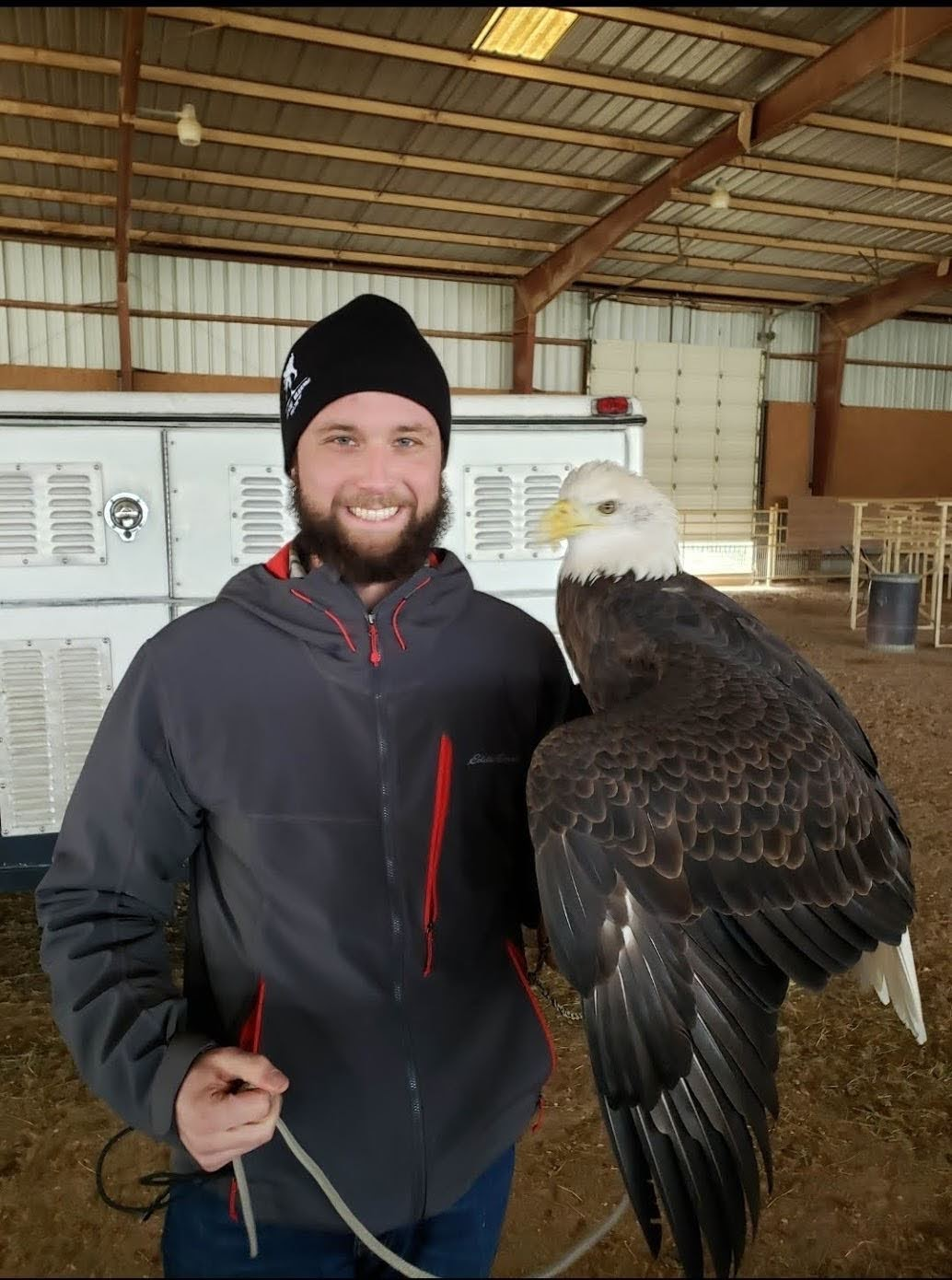
As I followed up with Wounded Warrior Project, they offered me a spot on an upcoming Project Odyssey occurring in Texas. An all-expense paid trip where WWP incorporated adventure and therapy to teach us more skills. On a ropes course, I experienced fear based on real things I was feeling in the moment. At a Birds of Prey demonstration by Last Chance Forever, I learned about DDT, its ill effects on birds of prey, and how these have declined since their widespread use. John Karger, Master Falconer, explained there was hope. We learned basic raptor biology, natural behaviors, insights into the plight of the natural world, and the human effects on the balance of living things. He went over rehabilitation techniques, the natural history of raptors, ecological awareness, and conservation measures. There were also demonstrations when the raptors flew, showing what they could do, and an opportunity for each of us to hold a bald eagle.
About a year later, in May 2020, I was driving on the road near an old airfield in Barnstable, a few miles from where I live. An object flew over my windshield and towards the field. “Ignore it, it’s probably nothing,” part of my mind immediately reported, but I was interested enough that I leaned forward to look up. I saw a Pterodactyl-sized bird blocking the sun with its dark body. Before I held that eagle or got by birding spark, I would have laughed at stopping to look at a bird. But not now.
First checking that no one was behind me in my rearview mirror, I slammed on my brakes and turned into a small parking lot. An adult bald eagle was standing on the ground 100 feet from me. I was astonished, and my curiosity led to locating the first active eagle’s nest on Cape Cod and photographing the first bald eagle chicklet to hatch in that nest. I was interviewed by Ally Hirschlag for the Audubon and was featured in This Bald Eagle Chick Is the First Hatched on Cape Cod in 115 Years.
Resistance
There were many times when I felt a nagging sensation to stop whatever I was doing because it was not important enough. This self-loathing told me the everyday tasks of post-combat and police life weren’t worth the sacrifices others I served with gave. According to Steven Pressfield, resistance is an impartial force of nature, like gravity and the laws of thermodynamics. It can deceive us into ceasing to follow our dreams. I relate to resistance and feel it whenever I see a bird I am interested in. My peripherals catch a bird in flight, and my brain tells me that it is undoubtedly just a crow or some bird I don’t care about. It is often just a crow or bird of disinterest, but sometimes I notice something about the birds I hadn’t before or feel awe as I watch their areal acrobatics. Sometimes, it is also a bird I didn’t expect.
Blue jay’s calls have led me to owls trying to sleep. Osprey’s calls have brought my attention to the bald eagles trying to take their fish for dinner. Shadows over my car have brought me to find the first active eagle nest in over a century and to experience life again. I don’t feel lucky or gifted in birding, but I can overcome resistance to be present and open to opportunities.
Processing intrusive thoughts or flashbacks may have similarities with photographic memory-assisted birding, but only in the experience. Sometimes when I am not thinking of birds, I will look into a woodline and almost see a negative image flash of a bird. I can’t point to where it is, and I cognitively want to discredit it, but when I have fought my resistance, I often find the universe rewarding me with a moment of awe with a bird of prey. In the same way, dead eyes, hanging bodies, and foreign streets used to flash, now I see birds. The critical difference is that I am not giving CPR, in combat, or threatened. The thing is over and gone. With Birding, however, the bird is there and real whether we see it or not.
An Encounter
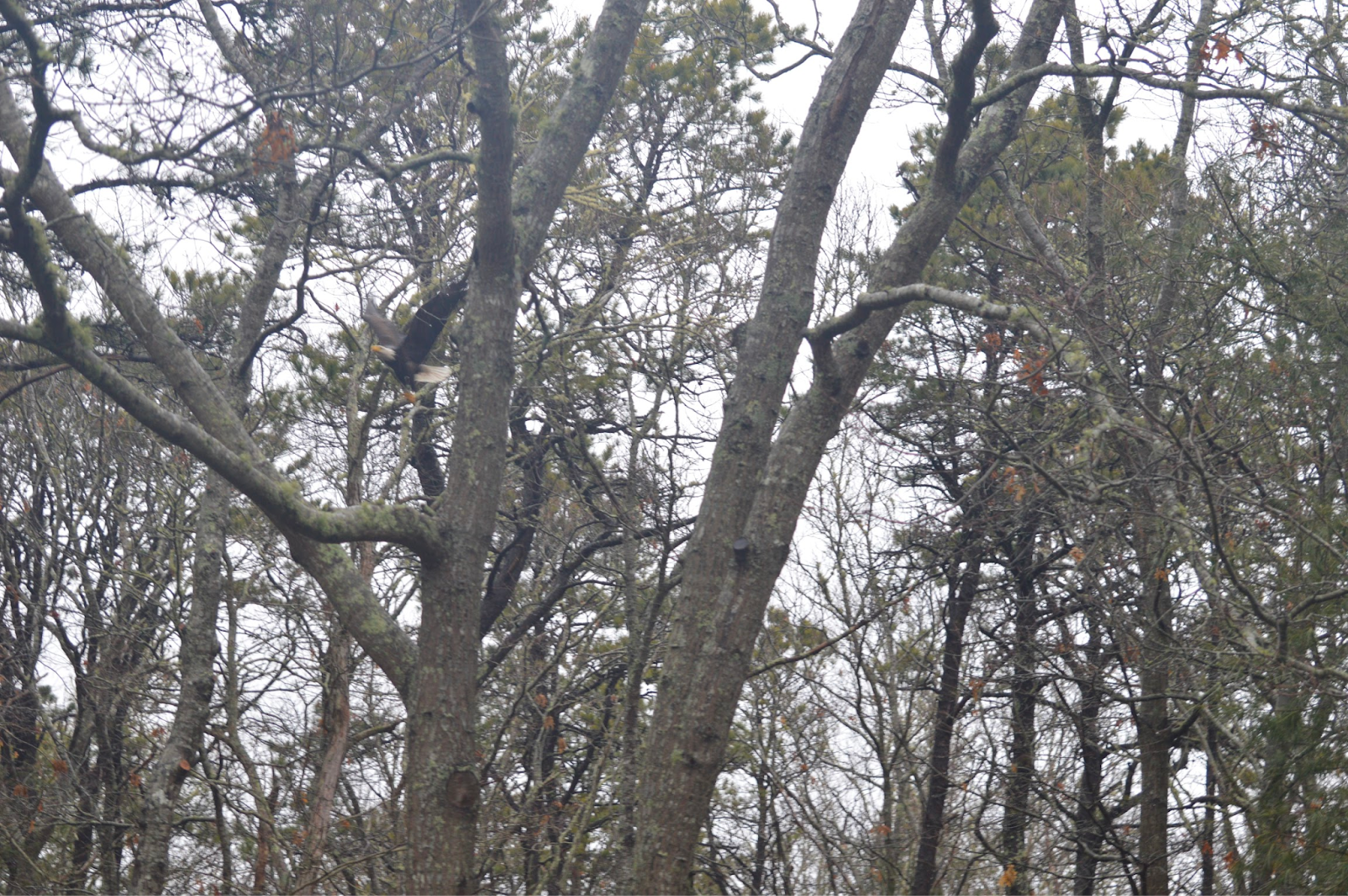
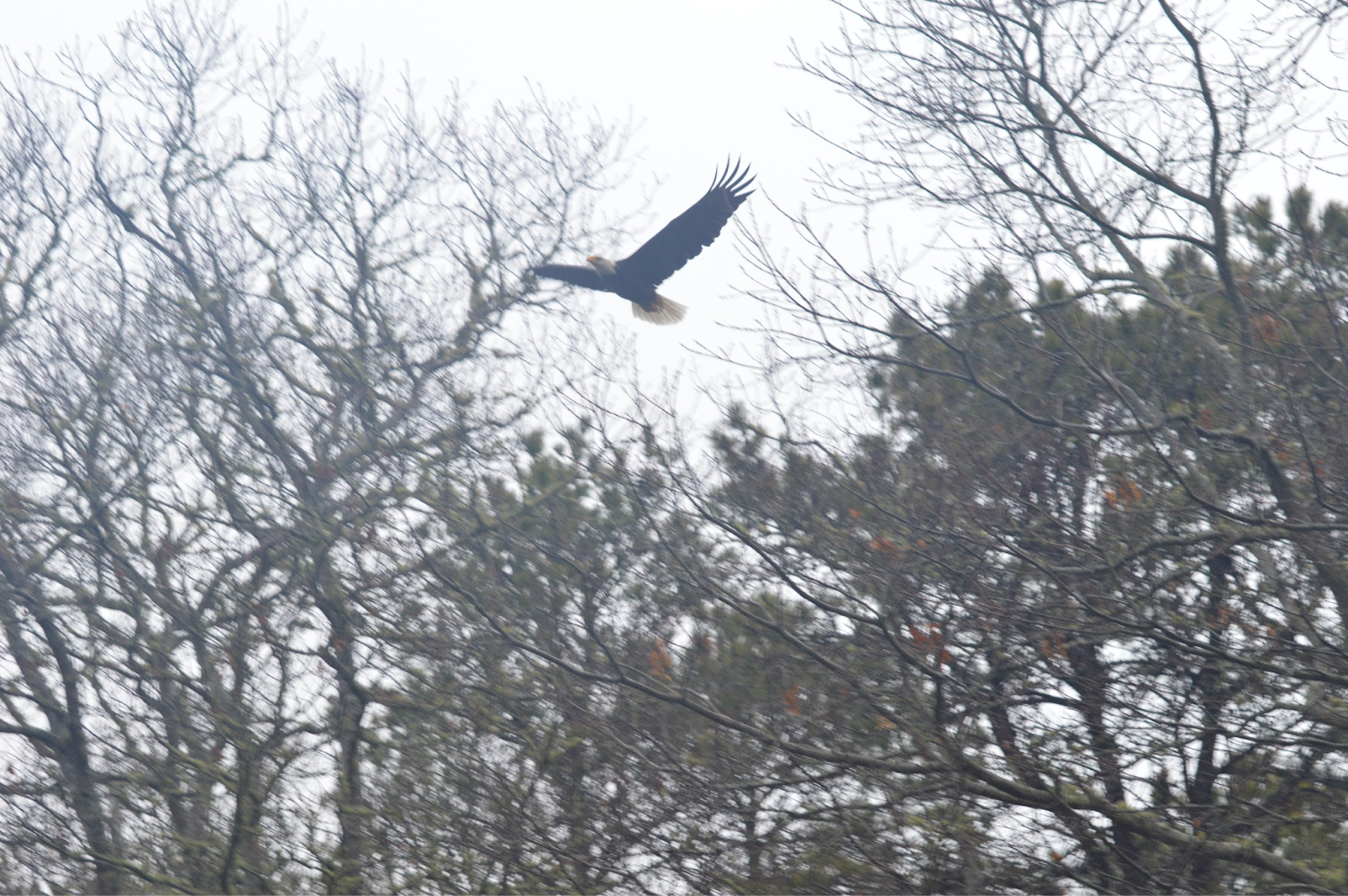
I headed to my wife’s yoga studio on a rainy Saturday morning to teach a class. I habitually keep my eyes to myself when I walk outside to avoid seeing things that may trigger me. Why let a tree snag or memories of Iraq ruin my day if they don’t need to? I check out when entering vehicles. In Iraq, I caught shrapnel to my left hand while running for cover, just as I grabbed the HMMWV driver’s door handle. Opening my Subaru door, I slumped into my seat and searched for my keys. I saw the flash of an eagle silhouette as I blinked. My eyes raised, and I saw a bald eagle 50 feet ahead, perched on a dead oak limb just behind my fence.
It didn’t feel real. I initially thought I was seeing things, but it was huge and had a clean white head and tail with bright yellow talons. The battery to my Nikon D3200 had been dead for months, but I had just charged it and put it in my car. In disbelief, I kept my eyes on the bird and reached for my camera. As I would with my M4 with an ACOG in the Army, I raised my camera, looked through sights, and squeezed.
Exponential is my birding journey, and I never expected to see a bald eagle in my yard. I snagged several photos of it through my windshield and then opened my sunroof, crawling over the center console for a below-defilade view. From here, I caught several clearer photos.
Suddenly, the bird began to open its wings as it jumped from the branch, soaring effortlessly across my yard, over my street, and high away. Less than a year ago, I recorded a podcast with Home Base Nation called What Yoga, Bird Watching, and Home Base All Have in Common – with U.S. Army veteran Joshua Maloney. I didn’t think I would find an eagle’s nest after that unattended death, and I didn’t think I would see and photograph a bald eagle in my own yard when I recorded that podcast.
Birding, like mental health, takes flexibility and mindfulness. I have to fight resistance and be willing to stop mid-task for an opportunity. Like the eagles themselves, I am thankful for a continued chance to cultivate a life worth living.

Special thanks to Charlie Daly. Not only for reviewing this for me but for motivating me in on his blog, The Lap. In a recent post titled The Big When, he writes to start before ready. Charlie is solo kayaking all the way around Ireland, but his guidance is applicable to anyone in any endeavor. “If I had to wait until I was “ready,” I would spend every summer on shore, poring over charts and tide tables, telling myself that I’ll be ready next June.”


 Joshua Maloney
Leave a reply to jim Bert Craddock Cancel reply