Joshua Maloney
As a tree climber, I rely on knots to suspend my weight high in the canopy. Bowlines, anchor hitches, and prussics all serve a specific purpose and are good at what they do, but each has limitations. Some knots cannot be untied once loaded (anchor hitch), while others will come free after a school bus is hung from them (bowline). Knots are in our clothes, electrical systems, and even our bodies. The surgeon ties the vas deferens in vasectomies, and stitching involves knot tying. The use of ropes for hunting, pulling, fastening, attaching, carrying, lifting, and climbing dates back to prehistoric times, and shoelaces are likely as old as shoes.
In hazardous environments such as mountains, knots are essential. In the event of someone falling into a ravine, with the correct equipment and knowledge of knots, a rappel system can be set up to lower a rescuer down to a casualty and set up a hauling system to allow a third individual to pull both the rescuer and the casualty out of the ravine.
There is one knot that starts and ends my day and keeps my boots on my feet. The bow knot is often overlooked. Shoe tying involves loosening the lacing, which allows the boot to open wide enough for the foot to be inserted or removed. Tightening the lacing and tying off the ends secures the foot firmly within the boot. Tie your boots the correct way, and they stay tied. Make a minor change, and you will be tripping over your laces.
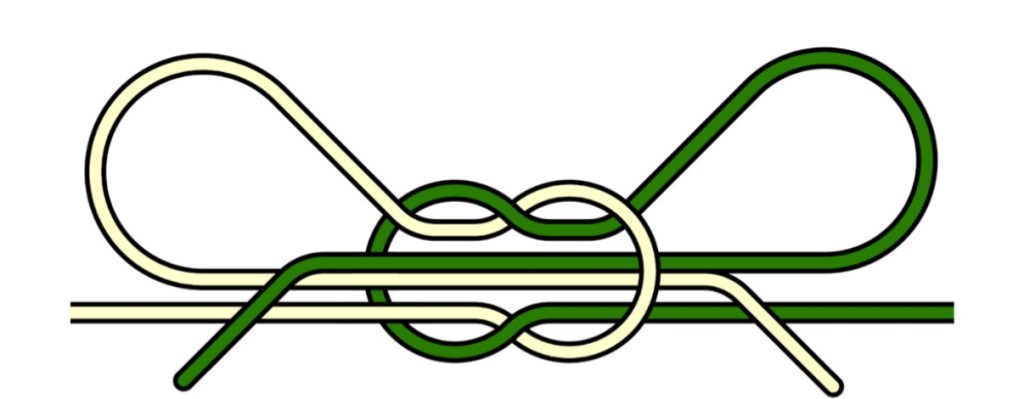
A bow knot or a doubly slipped reef knot is the name for the good old “loop, swoop, and pull.” It is designed for quick release when either of the working ends of the knot is pulled. The working ends of a rope are the ends you will most manipulate to tie a knot. This is where the aglet is, the plastic end of the lace (Trivia fact). The working end changes as the knot develops. As one prepares to tie, the foot should be snug in the back of the boot, the sole touching the sole of the boot. Cinch the laces tight. Pull them up and towards the calf, keeping the tongue tight. Ropes are funny like that. As tension pulls the rope, straight forces are exerted along the rope. That is, until the rope hits a hole, eyelet, loop, or hook on either side of the boot. These eyelets redirect the lace forces, closing the boot and keeping tension on the lace. So, as you pull up, the lace also pulls in and down.
Step one: Once at the top grommet. Pull the laces tight, wrap the top lace under the bottom lace, and pull it through. This is the beauty of knots; the tyer decides which is the top and which is the bottom. In most knot applications, it doesn’t matter; you can tie a knot upside down, and it is the same knot. Step two: Make a loop with one end of the shoelace. Step three: Wrap the other lace around the loop once. Step four: Make a small loop with the wrapped lace and pull it through the middle. For the best results, ensure the loops and laces are even on both sides of your bow knot.
A bow knot is a square or a granny knot with one difference: the working ends are formed into a bite and crossed together for the second trefoil.
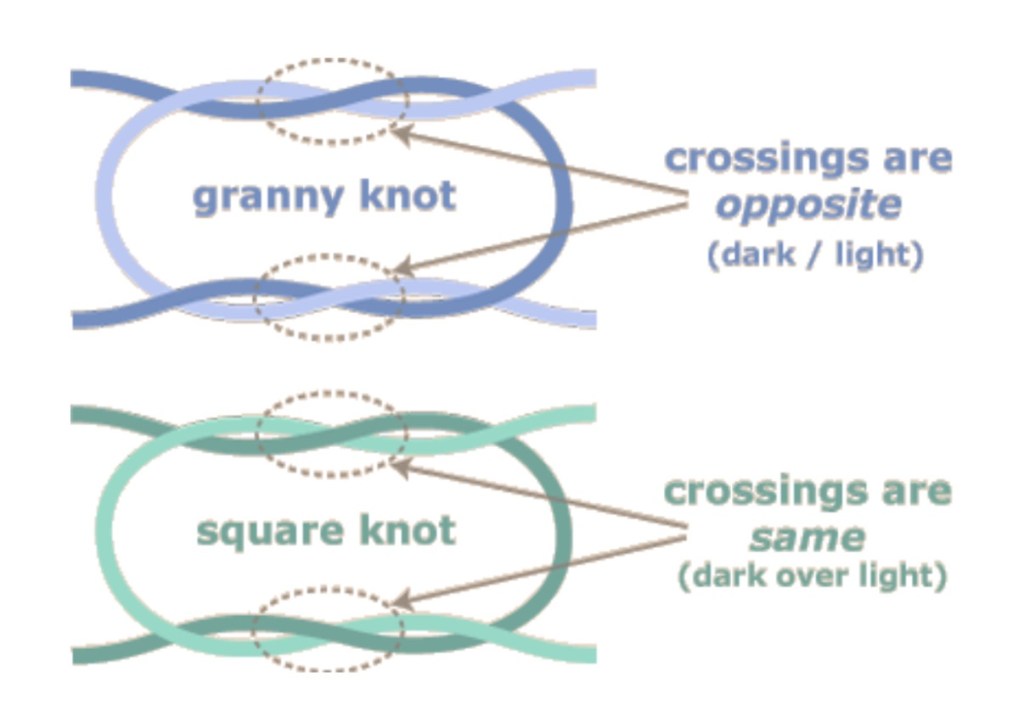
Square knot
In tracing the overlap/underlap of the dark (left-facing U) string, we start with the top part of the U and find that the string goes under, then over, then under the light string before rounding out the bottom of the U. After the u-turn, the dark string continues to go under, then over, then under the light string to return to the other open end of the U.
Granny knot
In tracing the overlap/underlap of the dark (left-facing U) string, we start with the top part of the U and find that the string goes over, then under, and then over the light string before rounding out the bottom of the U. After the u-turn, the dark string continues to go under, then over, then under the light string to return to the other open end of the U.
Differences
The basic difference between the two knots is that they have opposite under/over windings for the first part of the sideways U but the same under/over windings after the u-turn.
Knot Principles
But why does this work? What makes the knot stay tied? When a knot secures the shoelaces, the lace is crimped or squashed. Primarily, this is what stops the lace from coming undone. In effect, the lace is narrower inside the knot than on the loose end, and the loose end cannot make itself smaller and slide through the knot. All knots work on this principle. Knots work because the way they are tied creates friction between the strands of rope when tension is applied, causing them to interlock and resist pulling apart, essentially locking the knot in place due to the complex twisting and crossing of the strands against each other.
There are a few principles of knots. First, the more times the strands cross, the stronger the knot. The twisting of strands as they cross one another also plays a role: If the strands are twisted in opposite directions, the twist balances out, locking the knot into place. Finally, if adjacent strands slide in opposing directions as a knot is tightened, that also strengthens the knot. This is why the bow knot is so valuable. It’s composed of connecting two trefoil knots, the second trefoil being on a bight. The strands twisted in opposite directions lock the knot.
I tie my laces in a square knot, with an additional trefoil after the first two trefoils. Some say this isn’t the proper way to double-knot laces, saying an extra wrap is needed for the first or second overhand knot. I am also picky about my laces. I use Unbreakable Heavy Duty Hiking Work Boot Laces for my boots. They are not unbreakable, but they last in my dynamic work environment.
Did you know there were so many variations of shoe tying? So, how do you tie your shoes?
 Joshua Maloney
Leave a comment